




The best time to take turmeric can significantly impact its effectiveness, absorption, and how well it works for your specific health goals. While turmeric is beneficial at any time of day, strategic timing with meals, considering your condition, and consistency matter more than most people realize.
This complete guide answers the most common timing questions: morning or night, with food or empty stomach, how long before you see results, and optimal scheduling for arthritis, inflammation, sleep, and other conditions.
Quick Answer: The best time to take turmeric is with meals containing fat (breakfast or dinner) for maximum absorption. Morning is ideal for energy and anti-inflammatory benefits throughout the day. Evening works better if targeting sleep quality or nighttime inflammation. Consistency matters more than exact timing.
Morning vs Night: When Should You Take Turmeric?
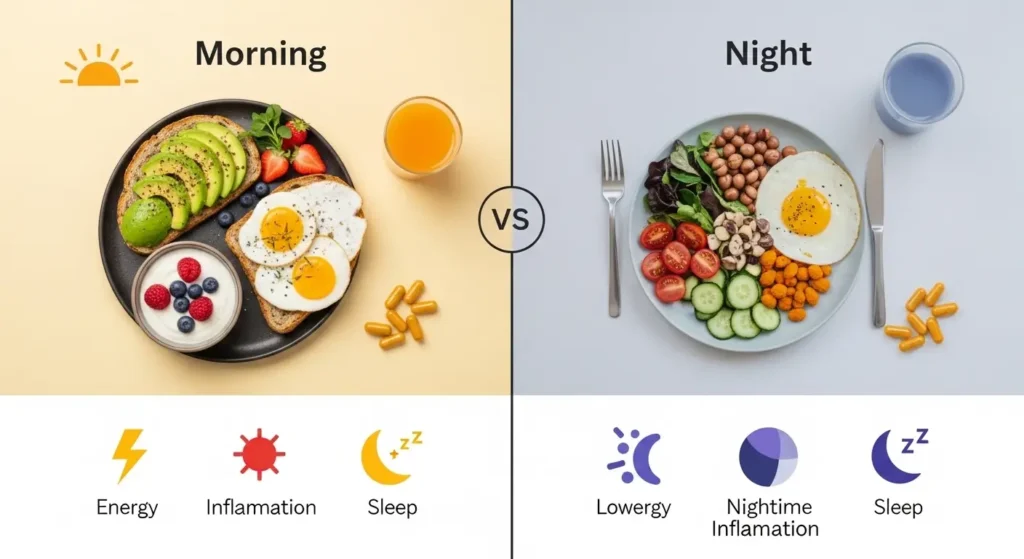
Morning: Best for Most People ⭐ RECOMMENDED
Why Morning Works Well:
✅ Supports daytime inflammation control
- Reduces inflammatory response throughout active hours
- Helps manage pain during daily activities
- Peak benefits when you need them most
✅ Provides sustained energy
- Anti-inflammatory effects reduce fatigue
- Won’t interfere with sleep (generally non-sedating)
- Pairs well with morning supplements
✅ Better adherence
- Easier to remember as part of morning routine
- Less likely to forget at end of busy day
- Consistent with breakfast timing
✅ Optimal for exercise
- Reduces exercise-induced inflammation
- Supports post-workout recovery
- Take 1-2 hours before workout for prevention
Best Morning Schedule:
- With breakfast (especially if contains healthy fats)
- After morning coffee (if taking separately)
- 30-60 minutes before exercise (if working out)
Evening: Best for Specific Conditions
When Evening Is Better:
✅ Sleep-related benefits
- May improve sleep quality (indirect through pain reduction)
- Reduces nighttime inflammation
- Helps morning stiffness (arthritis)
✅ Nighttime pain management
- Addresses pain that worsens at night
- Supports overnight healing and recovery
- Reduces morning joint stiffness
✅ Digestive issues
- Evening dose for overnight gut healing
- Reduces nighttime acid reflux (for some people)
- Supports morning digestive comfort
Best Evening Schedule:
- With dinner (for absorption)
- 1-2 hours before bed (not immediately before sleep)
- Consistent evening timing for best results
Split Dosing: The Best of Both 💡 OPTIMAL STRATEGY
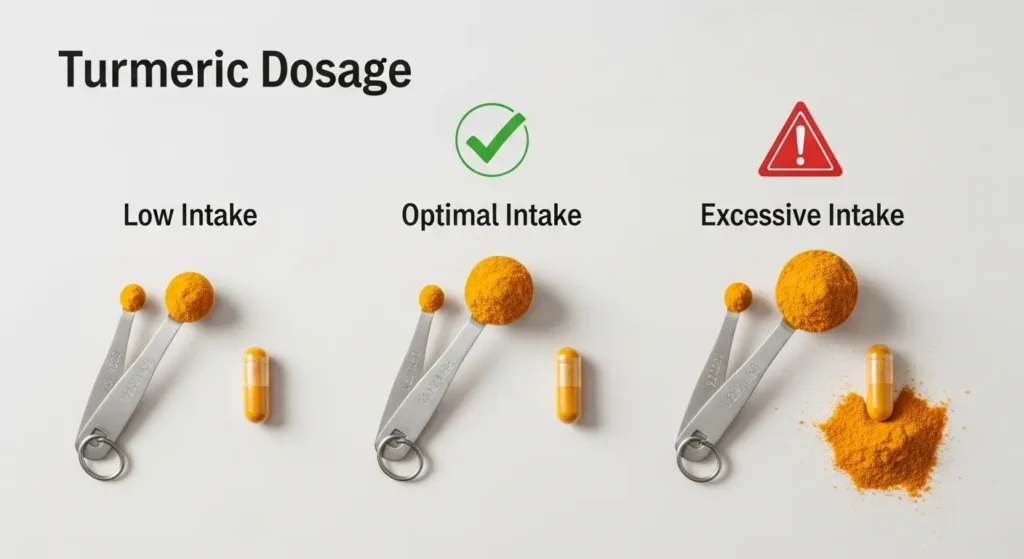
Why Split Dosing Works:
For doses of 1,000mg+ curcumin daily, splitting into two doses provides:
- More consistent blood levels throughout 24 hours
- Better overall absorption (body processes smaller amounts more efficiently)
- Sustained anti-inflammatory effects
- Flexibility for different needs
Recommended Split Schedule:
- Morning: 500-750mg with breakfast
- Evening: 500-750mg with dinner
- Total: 1,000-1,500mg daily
Research from Molecular Nutrition & Food Research shows curcumin blood levels peak 1-2 hours after ingestion and decline within 6-8 hours, supporting the benefit of split dosing.
With Food or Empty Stomach?
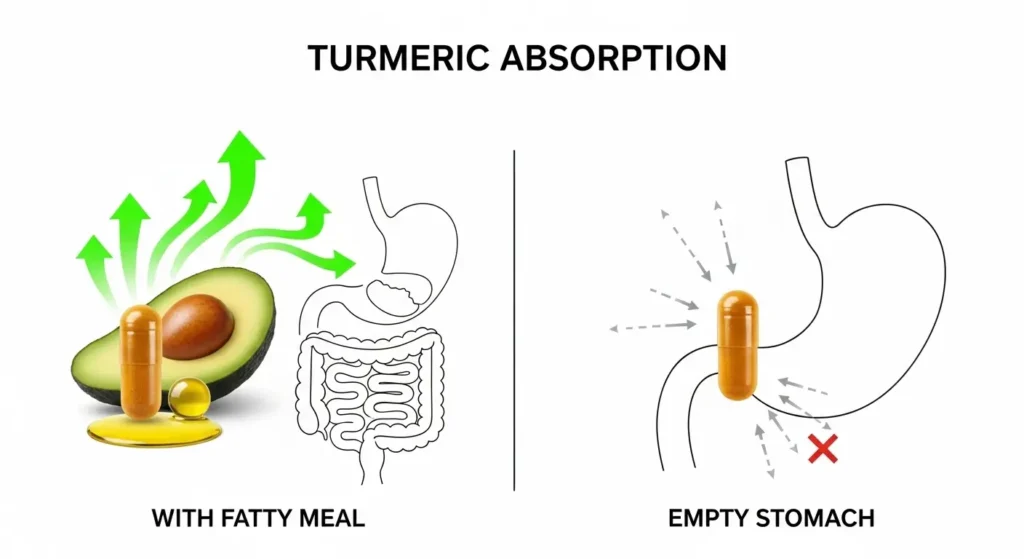
With Food (Especially Fat): BEST ⭐
Why Take Turmeric with Food:
✅ Dramatically Improves Absorption
- Curcumin is fat-soluble (needs fat for absorption)
- Food with fat can increase absorption by 7-8x
- Reduces likelihood of stomach upset
- Enhances bioavailability of most formulations
✅ Better Tolerance
- Prevents nausea (especially at higher doses)
- Reduces gastric irritation
- Less likely to cause digestive discomfort
- More sustainable long-term
Best Foods to Take Turmeric With:
High-Fat Options (Ideal):
- Eggs (breakfast)
- Avocado toast
- Nut butter on toast
- Greek yogurt with nuts
- Salmon or fatty fish
- Olive oil-based meals
- Coconut oil coffee/smoothie
Moderate-Fat Options (Good):
- Regular meals with some fat content
- Whole milk (if dairy tolerant)
- Cheese
- Dark chocolate (bonus: synergistic antioxidants)
Meal Timing: Take turmeric 15-30 minutes before eating or during your meal, not hours after.
Empty Stomach: Generally Not Recommended
Why Empty Stomach Is Less Ideal:
❌ Poor Absorption
- Without fat, curcumin absorption drops significantly
- May reduce effectiveness by 70-80%
- Defeats purpose of supplementation
❌ Digestive Discomfort
- Higher risk of nausea
- May irritate stomach lining
- Especially problematic at doses 1,000mg+
Exception: Some enhanced formulations (liposomal, phytosome) may work on empty stomach, but still better with food.
Timing for Specific Health Conditions
For Arthritis and Joint Pain
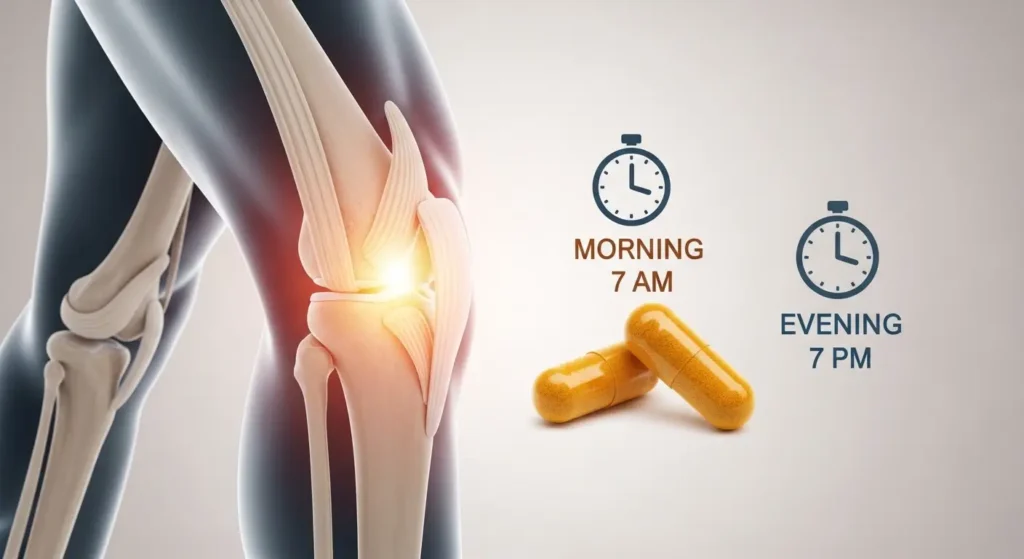
Optimal Schedule:
- Morning dose: 500-1,000mg with breakfast
- Reduces morning stiffness
- Provides daytime pain relief
- Supports mobility during active hours
- Optional evening dose: 500-750mg with dinner
- Prevents nighttime inflammation
- Reduces morning stiffness next day
- For severe arthritis, split dosing recommended
Clinical Insight: Studies show arthritis patients benefit from consistent twice-daily dosing. Research in Journal of Medicinal Food found morning + evening dosing superior to single daily dose.
Timeline: Allow 4-8 weeks for maximum arthritis benefits.
For complete arthritis guidance, see our turmeric curcumin benefits guide.
For Digestive Issues (IBS, IBD, Gut Inflammation)
Optimal Schedule:
- With each main meal: 300-500mg
- Breakfast, lunch, and dinner
- Supports continuous gut protection
- Reduces meal-induced inflammation
- Alternative: Twice daily (breakfast and dinner)
- 500-750mg each dose
- Provides sustained gut healing
Important: Always with food for digestive conditions—never empty stomach.
Special Consideration: If experiencing GERD/acid reflux, monitor response. Some people find turmeric helpful, others may experience worsening. Start low and adjust.
For Brain Health and Memory
Optimal Schedule:
- Morning: 400-500mg (especially Longvida formulation)
- Supports daytime cognitive function
- Enhances mental clarity when needed most
- Neuroprotective effects during active hours
Best Formulation: Longvida curcumin (crosses blood-brain barrier) See our best turmeric supplements review for brain-specific options.
Timeline: Cognitive benefits typically require 8-12 weeks of consistent use, as shown in UCLA research.
For Exercise Recovery and Performance

Optimal Schedule:
Pre-Workout (Prevention):
- 200-500mg 1-2 hours before exercise
- Reduces exercise-induced inflammation
- May enhance recovery
- Prevents excessive oxidative stress
Post-Workout (Recovery):
- 500-1,000mg within 1-2 hours after exercise
- Reduces muscle soreness (DOMS)
- Accelerates recovery
- Anti-inflammatory for stressed tissues
Daily (For Athletes):
- 500mg morning + 500mg evening
- Maintains baseline anti-inflammatory state
- Supports ongoing training adaptation
Studies show turmeric reduces muscle damage markers and soreness by 30-50% when taken consistently around workouts.
For General Inflammation and Wellness
Optimal Schedule:
- Morning with breakfast: 500-1,000mg
- Simple, sustainable routine
- Daytime anti-inflammatory coverage
- Easy to remember
Alternative (Higher Doses):
- Split 1,000-1,500mg between breakfast and dinner
- More even anti-inflammatory effect
- Better for chronic conditions
For Sleep Quality
Optimal Schedule:
- Evening with dinner: 500-1,000mg
- 2-3 hours before bed (not immediately before)
- Reduces pain that disrupts sleep
- Anti-inflammatory support during rest
Note: Turmeric itself doesn’t cause drowsiness, but reducing pain/inflammation may improve sleep quality indirectly.
For direct sleep support, consider reishi mushroom instead.
How to Take Turmeric: Step-by-Step
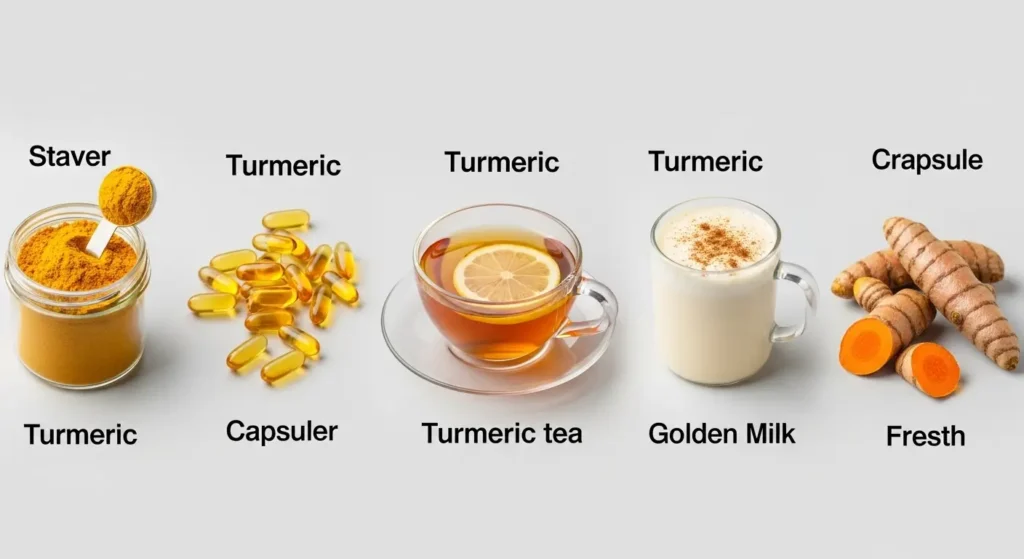
Method 1: Capsules/Tablets (Most Common)
Steps:
- Take with meal containing fat
- Swallow with full glass of water (8-12 oz)
- If splitting dose, space 8-12 hours apart
- Take at same times daily for consistency
Pro Tip: If capsules are large, taking with thick liquid (smoothie, yogurt drink) makes swallowing easier.
Method 2: Powder (Mixed)
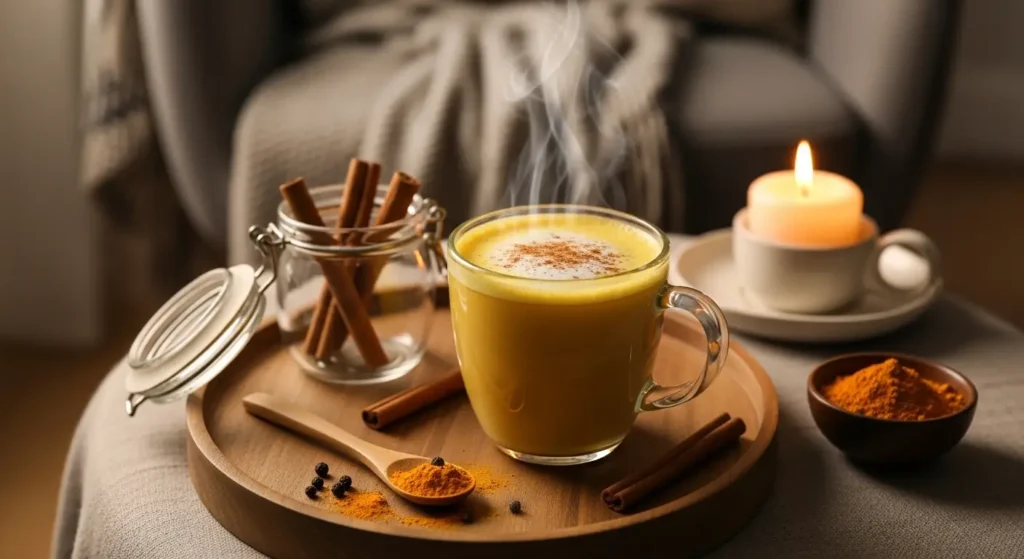
Golden Milk Recipe (Morning or Evening):
Ingredients:
- 1 tsp turmeric powder
- 1 cup milk (dairy or coconut milk for fat)
- 1/4 tsp black pepper (enhances absorption 2,000%)
- 1/2 tsp cinnamon
- 1 tsp honey
- Pinch ginger powder

Instructions:
1. Warm milk on stove (don't boil)
2. Whisk in turmeric, pepper, spices
3. Simmer 5 minutes
4. Add honey after removing from heat
5. Drink warm
Best Time: Morning for energy, evening for relaxation ritual.
Method 3: Smoothie Addition
Absorption-Enhanced Smoothie:
- 1 tsp turmeric powder
- 1/4 tsp black pepper
- 1 tbsp coconut oil or almond butter (fat for absorption)
- Banana, berries, spinach
- Liquid base (coconut milk recommended)
Best Time: Morning as breakfast replacement or post-workout.
What About Interactions and Timing with Other Supplements?
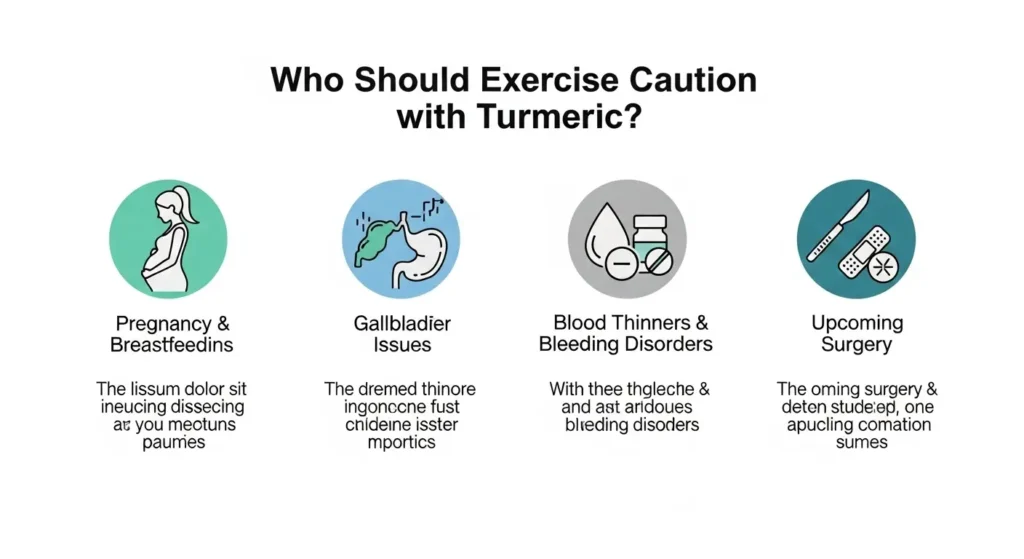
Turmeric + Other Supplements
Can Take Together:
- ✅ Omega-3s (Fish Oil) – Synergistic anti-inflammatory
- ✅ Vitamin D – Complementary benefits
- ✅ Ginger – Enhanced anti-inflammatory
- ✅ Medicinal Mushrooms – Complementary immune/inflammation support
- ✅ Probiotics – Different mechanisms, safe together
Space Apart (2+ Hours):
- ⚠️ Iron Supplements – Turmeric may inhibit iron absorption
- ⚠️ Calcium – May compete for absorption (minimal concern)
Consult Healthcare Provider:
- ⚠️ Blood Thinners – Turmeric may enhance effects
- ⚠️ Diabetes Medications – May lower blood sugar
- ⚠️ Stomach Acid Reducers – Timing matters
For complete interaction information, see our anti-inflammatory herbs guide.
How Long Until Turmeric Works?
Timeline for Results
Acute Effects (Days to 2 Weeks):
- Reduced exercise soreness: 2-3 days
- Minor pain relief: 3-7 days
- Digestive comfort: 1-2 weeks
Moderate Effects (2-4 Weeks):
- Noticeable inflammation reduction
- Improved joint mobility
- Better energy levels
- Reduced inflammatory markers (if testing)
Maximum Effects (6-12 Weeks):
- Arthritis pain reduction (50-60% in studies)
- Cognitive improvements
- Significant inflammatory marker reduction
- Optimal chronic disease benefits
Key Factor: Consistency matters more than perfect timing. Taking turmeric daily at roughly the same time(s) produces better results than sporadic use at “perfect” times.
Research from Phytotherapy Research shows benefits accumulate with consistent use over 8-12 weeks.
Common Timing Mistakes to Avoid
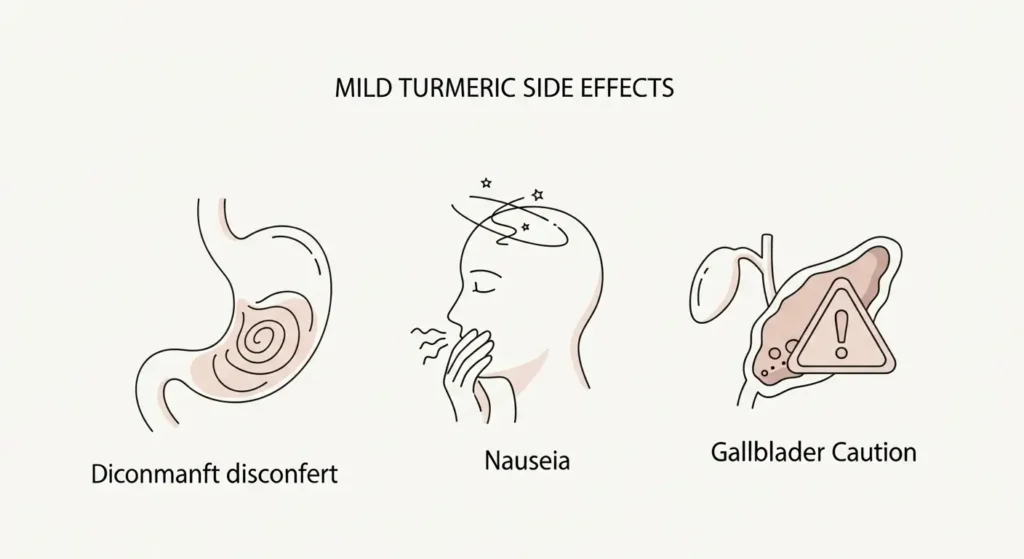
❌ Taking on Completely Empty Stomach
Why It’s Wrong: Reduces absorption by 70-80%, may cause nausea Better Approach: Always with at least a small snack containing fat
❌ Taking Right Before Bed
Why It’s Wrong: May cause mild stimulation in some people, digestive discomfort when lying down Better Approach: Take 2-3 hours before bed with dinner
❌ Inconsistent Timing
Why It’s Wrong: Makes it hard to assess effectiveness, disrupts steady blood levels Better Approach: Set daily reminder, take at same time(s)
❌ Taking Only When You Remember
Why It’s Wrong: Benefits are cumulative—sporadic use provides minimal benefit Better Approach: Build into daily routine (with breakfast/dinner)
❌ Expecting Immediate Results
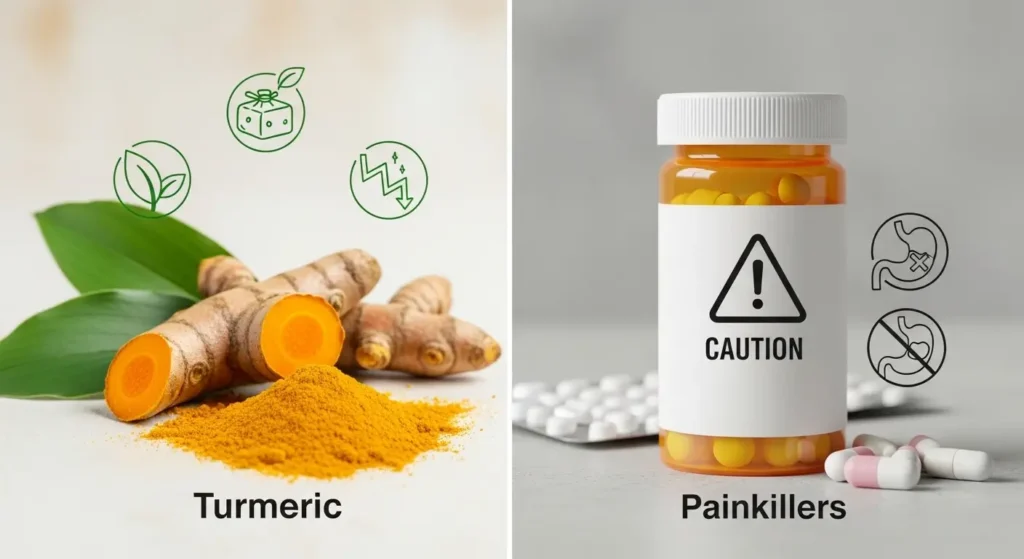
Why It’s Wrong: Turmeric isn’t a painkiller—it reduces inflammation gradually Better Approach: Commit to 4-8 weeks before evaluating effectiveness
❌ Taking Too Close to Iron Supplements
Why It’s Wrong: May reduce iron absorption Better Approach: Space turmeric and iron 2-3 hours apart
Optimizing Absorption: Beyond Timing
While timing matters, these factors impact absorption even more:
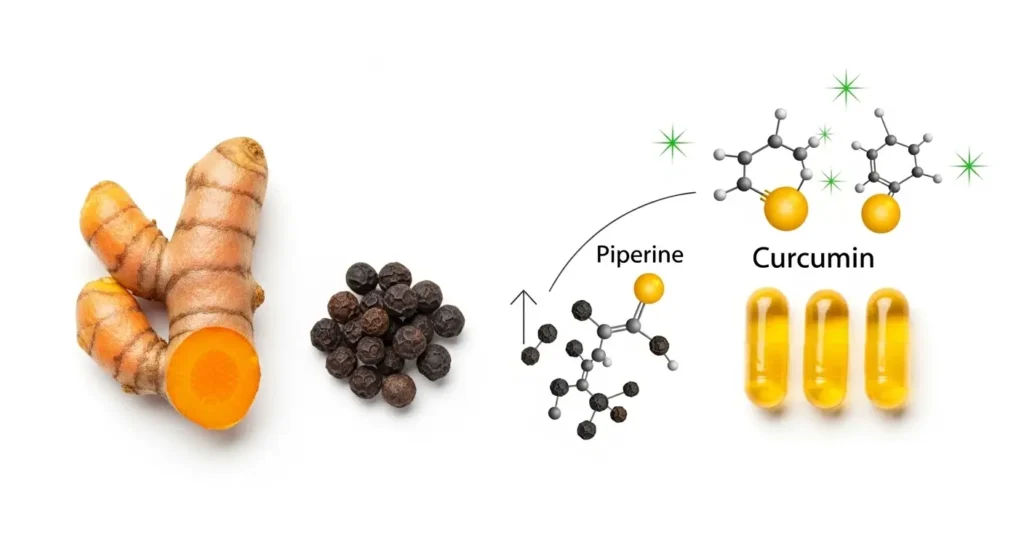
1. Bioavailability Enhancement (Most Important)
Standard curcumin has 1-2% absorption. Choose enhanced formulations:
- Phytosome (Meriva): 29x absorption
- Liposomal: 30x absorption
- BCM-95: 7x + longer duration
- With BioPerine (Black Pepper): 20x absorption
See our best turmeric supplements review for tested options.
2. Take with Dietary Fat
Best Fat Sources:
- Coconut oil, olive oil, avocado oil
- Nuts, nut butters, seeds
- Fatty fish, eggs
- Full-fat dairy (if tolerated)
- Avocado
How Much: Even 5-10g fat significantly improves absorption (1 tbsp oil ≈ 14g fat)
3. Add Black Pepper
If your supplement doesn’t contain BioPerine:
- Add 1/4 tsp black pepper to turmeric powder
- Increases absorption by 2,000%
- Works by inhibiting liver metabolism
4. Consistency Over Perfection
Taking turmeric at 7am vs 9am matters far less than:
- Taking it daily without missing
- With adequate fat
- Using enhanced formulation
- Giving it 6-8 weeks minimum
Sample Turmeric Schedules
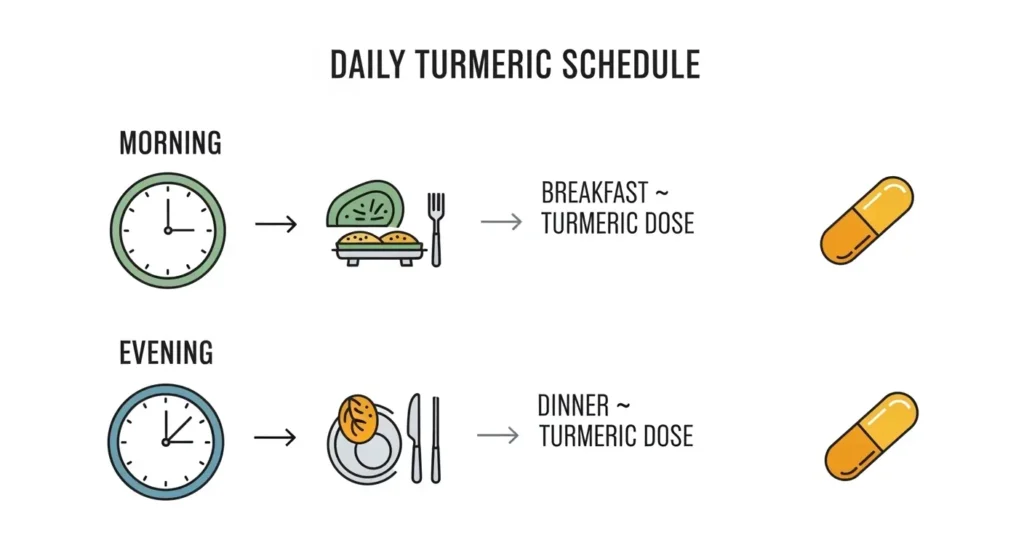
Schedule 1: Basic Single Dose (General Wellness)
Morning:
7:00 AM - Breakfast with healthy fats (eggs, avocado, nuts)
7:30 AM - Take 1,000mg turmeric curcumin with water

Consistency: Daily, same time
Best for: General anti-inflammatory, prevention
Schedule 2: Split Dose (Arthritis, Chronic Inflammation)
Morning:
7:00 AM - Breakfast with fats
7:30 AM - Take 750mg turmeric

Evening:
6:30 PM - Dinner with fats
7:00 PM - Take 750mg turmeric

Total: 1,500mg daily
Best for: Arthritis, chronic pain, inflammatory conditions
Schedule 3: Athletic Performance
Pre-Workout:
8:00 AM - Light breakfast with fats
8:30 AM - Take 400mg turmeric
10:00 AM - Workout

Post-Workout:
11:30 AM - Post-workout meal
12:00 PM - Take 600mg turmeric

Evening (Rest Days):
7:00 PM - Take 500mg with dinner

Best for: Athletes, exercise recovery, performance
Schedule 4: Digestive Health
Breakfast:
7:30 AM - Take 400mg with breakfast

Lunch:
12:30 PM - Take 400mg with lunch

Dinner:
7:00 PM - Take 400mg with dinner

Total: 1,200mg daily split across meals
Best for: IBS, IBD, gut inflammation
Frequently Asked Questions
-
Should I take turmeric in the morning or at night?
Morning is best for most people as it provides daytime anti-inflammatory coverage and is easier to remember. Take it at night if you have nighttime pain, morning stiffness, or sleep disruption from inflammation. Split dosing (morning + evening) is optimal for chronic conditions.
-
Can I take turmeric on an empty stomach?
Not recommended. Turmeric taken without food (especially fat) has 70-80% lower absorption and may cause nausea. Always take with meals or at least a small snack containing healthy fats for maximum effectiveness.
-
How long before turmeric starts working?
Minor effects appear in 3-7 days, noticeable benefits in 2-4 weeks, and maximum effects in 6-12 weeks. Consistency is crucial—take daily without missing doses. Acute pain relief happens faster than chronic inflammation reduction.
-
Should I take turmeric before or after meals?
Take during or within 30 minutes of meals, ideally meals containing fats. The fat content enhances absorption significantly. Timing relative to the meal (slightly before, during, or right after) matters less than ensuring you take it with food.
-
Can I take turmeric before bed?
Yes, but take it with dinner (2-3 hours before bed) rather than immediately before sleep. This prevents digestive discomfort when lying down and allows absorption during digestion. Evening dosing helps with nighttime inflammation and morning stiffness.
-
How many times a day should I take turmeric?
For doses under 1,000mg: Once daily (morning with breakfast). For 1,000-1,500mg: Split into two doses (morning and evening). For 2,000mg+: Split into 2-3 doses throughout the day. Split dosing provides more consistent blood levels and better overall absorption.
-
Can I take turmeric with coffee?
Yes, but take turmeric separately with food. If making turmeric coffee (latte), add fat (coconut oil, MCT oil) and black pepper for absorption. Coffee itself doesn’t enhance or reduce turmeric absorption significantly.
-
Does timing affect turmeric’s effectiveness?
Timing matters, but not as much as: (1) taking with fat, (2) using enhanced bioavailability formulation, (3) consistent daily use, and (4) adequate dosage. Morning vs evening makes less difference than these core factors. Choose timing that supports consistency.
The Bottom Line on Turmeric Timing

The best time to take turmeric is when you’ll take it consistently, with meals containing fat, using an enhanced bioavailability formulation. While timing optimization can provide marginal benefits, the foundational factors that matter most are:
Priority Order:
- Consistency (daily without missing) – Most Important
- With dietary fat (7-8x absorption boost) – Critical
- Enhanced formulation (20-30x absorption) – Essential
- Adequate dosage (500-1,500mg for most) – Important
- Timing (morning vs evening) – Helpful but Secondary
Recommended Timing:
- ✅ For most people: Morning with breakfast (containing fats)
- ✅ For chronic conditions: Split between morning and evening
- ✅ For athletes: Pre- and post-workout, plus daily baseline
- ✅ For sleep issues: Evening with dinner (2-3 hours before bed)
- ✅ For gut health: With each main meal (3x daily)
Key Success Factors:
- Take at same time(s) daily
- Always with meals containing fat
- Use enhanced bioavailability formulations
- Give it 6-8 weeks minimum
- Be patient and consistent
Ready to start? Choose your optimal timing based on your health goals, then select a high-quality supplement from our best turmeric supplements review.
Learn more about turmeric:
Medical Disclaimer: This article is for informational purposes only. Turmeric timing recommendations should complement, not replace, medical advice. Consult healthcare providers before starting turmeric, especially if you have medical conditions, take medications, are pregnant/nursing, or before surgery.
Last Updated: January 2026