
You just bought rhodiola rosea after reading about its energy-boosting, stress-busting benefits. The bottle says “take one capsule daily,” but conveniently leaves out the most important detail: WHEN?
You Google it. One website says morning. Another says it doesn’t matter. A Reddit thread has people swearing by afternoon doses. Someone’s aunt takes it before bed and claims it helps her sleep (spoiler: that’s probably placebo or she’s taking something else).
So what’s the actual answer?
Let me save you hours of research and trial-and-error: Take rhodiola in the morning. Preferably on an empty stomach, 30 minutes before breakfast. Or with breakfast if empty stomach bothers you. Definitely not at night unless you enjoy staring at your ceiling fan at 2 AM.
In this article, I’ll explain exactly why timing matters for rhodiola, what happens if you get it wrong, and how to optimize your dosing schedule based on your specific goals.
Let’s dive in.
🛒 Affiliate Disclosure: This article contains affiliate links. We may earn a commission when you purchase through our links at no extra cost to you. Full disclosure
⚠️ Medical Disclaimer: This is educational information, not medical advice. Consult your healthcare provider before starting any supplement. Full disclaimer
📋 TL;DR – Quick Answer
Best Time to Take Rhodiola:
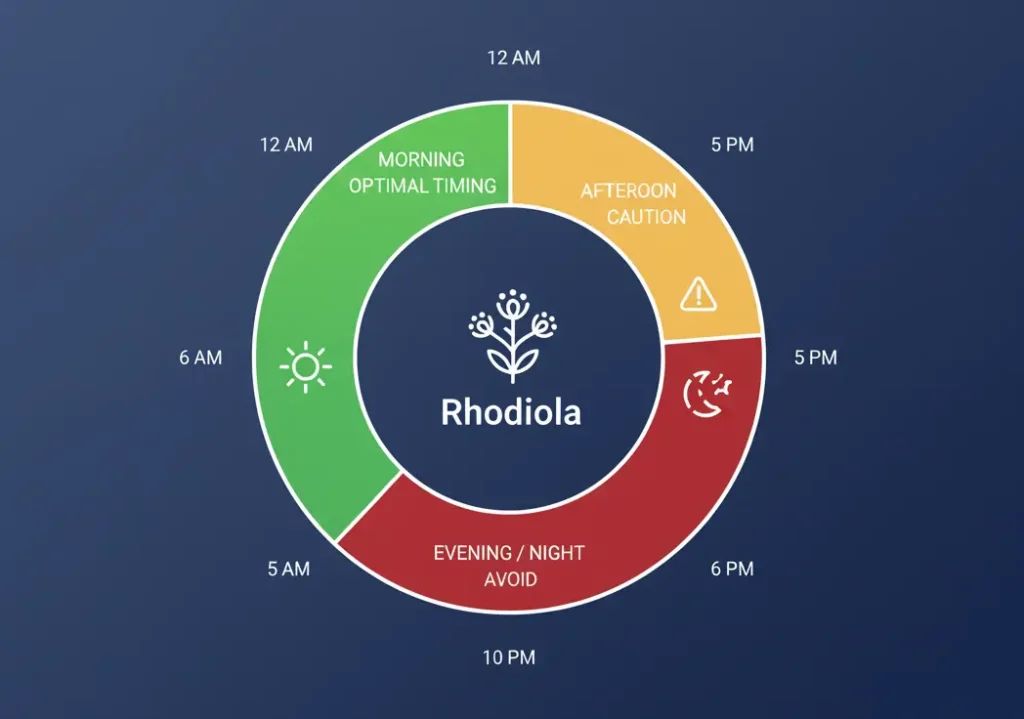
✅ Morning (6-8 AM) – Ideal for most people
✅ Early afternoon – Acceptable if you need a midday boost
⚠️ After 2-3 PM – Risk of sleep disruption
❌ Evening/Night – Will likely keep you awake
Why: Rhodiola is stimulating and energizing, not sedating. It increases alertness, mental energy, and physical stamina. Taking it at night is like drinking espresso before bed—some people can do it, but most will regret it.
Quick Start Guide:
- Take 300-600mg in the morning
- Empty stomach preferred (30 min before eating)
- Or with breakfast if you’re sensitive
- Wait 30-60 minutes to feel effects
- Enjoy sustained energy without jitters
Now let’s get into the details.
The Short Answer: Morning is Best (And Here’s Why)
Rhodiola rosea is what’s called an “energizing adaptogen.” While adaptogens as a class help your body manage stress, they don’t all work the same way.
Two types of adaptogens:
🌅 Stimulating adaptogens (take in morning):
- Rhodiola
- Cordyceps
- Eleuthero (Siberian ginseng)
- Asian ginseng
🌙 Calming adaptogens (take at night):
- Ashwagandha
- Reishi mushroom
- Holy basil (balanced, can go either way)
Rhodiola falls firmly in the “stimulating” category. It:
- Increases dopamine and norepinephrine (your “get up and go” neurotransmitters)
- Enhances cellular energy production
- Improves mental alertness and focus
- Reduces physical and mental fatigue
- Supports your body’s natural cortisol rhythm
Think of rhodiola as nature’s alternative to coffee—not as a sleep aid. You wouldn’t drink a double espresso at 9 PM (well, most of you wouldn’t), so don’t take rhodiola at night either.
The optimal window: 6-8 AM
This aligns with your body’s natural cortisol curve. Your cortisol levels are naturally highest in the morning, which helps you wake up and feel alert. Rhodiola works synergistically with this rhythm, enhancing your natural energy rather than fighting against it.
Acceptable alternative: Before lunch (11 AM – 12 PM)
If you forgot your morning dose or need an afternoon boost, taking rhodiola before lunch can work. Just make sure it’s not later than 2 PM, or you risk interfering with sleep.
What to avoid: After 2-3 PM
The closer you get to evening, the more likely rhodiola will disrupt your sleep. Even if you don’t consciously feel “wired,” it can affect sleep quality, leaving you less rested the next day.
Why Timing Matters for Rhodiola
Unlike vitamins or minerals that work more slowly over time, rhodiola has relatively fast-acting effects. Understanding how it works helps explain why timing is crucial.
Rhodiola’s Mechanism of Action (The Simple Version)
When you take rhodiola, its active compounds—rosavins and salidrosides—get to work quickly:
Within 30-60 minutes:
- Increases dopamine and norepinephrine in your brain
- These are your “alertness and motivation” neurotransmitters
- You start feeling more energized and mentally clear
Within 1-2 hours:
- Peak concentration in your bloodstream
- Maximum effects on energy and focus
- Enhanced physical stamina if you’re exercising
Duration of effects:
- Noticeable energy boost: 4-6 hours
- Subtle adaptogenic effects: Throughout the day
The problem with evening dosing: If these effects peak at 9 PM, right when your brain should be winding down, you’re fighting against your natural sleep drive.
The Cortisol Connection
Here’s where it gets interesting. Rhodiola doesn’t just randomly boost energy—it works with your body’s stress response system, particularly your cortisol rhythm.
Your natural cortisol curve:
- Highest: 6-8 AM (helps you wake up)
- Gradually decreases throughout the day
- Lowest: Evening/night (allows you to sleep)
Rhodiola’s effect: It helps optimize this rhythm, supporting healthy cortisol levels when you need them (morning) and preventing stress-induced cortisol spikes.
Taking it in the morning: Works with your natural rhythm = synergy, better results.
Taking it at night: Forces your cortisol system to be active when it should be resting = disrupted sleep, grogginess next day.
It’s like pushing someone on a swing. Time it right (morning), and you amplify the natural motion. Time it wrong (night), and you’re working against the momentum.
What Happens If You Take Rhodiola at Night
Let’s hear from people who learned this lesson the hard way.
Reddit user in r/Nootropics: “Took 500mg of rhodiola at 7 PM because I had a late work deadline. Big mistake. I finished my work, but then I was up until 2 AM with my mind racing, unable to shut off my thoughts. Learned my lesson.”
Another from r/Supplements: “Made the newbie mistake of taking rhodiola before bed, thinking ‘adaptogen = helps with sleep.’ Nope. Wide awake for hours. It’s nothing like ashwagandha.”
Common night-time dosing problems:
- Difficulty falling asleep (mind too active)
- Restless, low-quality sleep even if you do fall asleep
- Vivid dreams or even nightmares
- Waking up in the middle of the night alert
- Feeling tired but wired
The science: Rhodiola stimulates your sympathetic nervous system—the “fight or flight” part. This is great when you need to be alert and productive, terrible when you’re trying to activate your parasympathetic nervous system (rest and digest) for sleep.
Bottom line: Unless you’re a shift worker about to start a night shift, keep rhodiola far away from bedtime.
The Optimal Rhodiola Timing Schedule
Let’s get specific. Here are the best timing strategies based on your goals.
For Most People: General Stress & Energy
The Protocol:
🌅 6:00-8:00 AM - Wake up
⏰ 6:15 AM - Take rhodiola (300-600mg) on empty stomach
⏳ Wait 30 minutes (shower, get ready)
🍳 7:00 AM - Eat breakfast
💪 Feel effects kick in by 7:30-8:00 AM
Why this works:
- Empty stomach absorption is faster and more complete
- Effects align with your morning cortisol peak
- Energy carries you through your most productive hours
- Completely worn off by bedtime
- Establishes a consistent routine
If empty stomach bothers you: Just take it with breakfast. You’ll still get 80-90% of the benefits, and compliance (actually taking it every day) matters more than perfect optimization.
For Athletes & Pre-Workout Energy
The Protocol:
⏰ 60-90 minutes before exercise
📦 Take rhodiola (400-600mg)
🍌 Optional: light snack (banana, toast)
🏋️ Warm up
💥 Train with enhanced endurance and focus
Why this works:
- Peak effects hit during your workout
- Enhanced physical endurance (multiple studies support this)
- Better mental focus during training
- Reduced perceived exertion (exercise feels easier)
- Faster recovery post-workout
Reddit athlete reports: “I take rhodiola 90 minutes before my runs. I consistently shave 30-60 seconds off my 5K times. The difference is noticeable.”
“Use it before heavy lifting days. My work capacity goes up—I can do more sets before hitting failure.”
Pro tip: Rhodiola + cordyceps mushroom is a popular pre-workout combo in the biohacking community. Both are energizing adaptogens that work synergistically.
For Shift Workers
The Protocol:
⏰ Take at the start of YOUR "day"
- Even if that's 6 PM for a night shift
- Align with your personal circadian rhythm
- Don't take within 6-8 hours of when you plan to sleep
Why this works:
- Adapts to your unique schedule
- Provides alertness when YOU need it
- Respects your personal sleep-wake cycle
Important: If you work rotating shifts, rhodiola might not be ideal. Its energizing effects work best with a consistent schedule.
For Exam Prep & Study Sessions
The Protocol:
⏰ 30-60 minutes before studying
📚 Morning or early afternoon sessions only
☕ Can pair with moderate coffee (carefully)
💧 Stay well hydrated
🧠 Enhanced focus and memory consolidation
Why this works:
- Peak cognitive effects during study time
- Improved focus and concentration
- Better stress management during exams
- Enhanced memory formation
Reddit student experience: “Used rhodiola during finals week. Stayed focused for longer study sessions without the anxiety spiral I usually get. Felt like my brain was running smoother.”
Warning: Don’t take it late afternoon/evening even for studying. Sleep is MORE important than cramming, and rhodiola will interfere with sleep if taken too late.
Empty Stomach vs. With Food: What Works Better?
This is one of those “it depends” questions, but let me break down the pros and cons.
Empty Stomach (30 min before eating)
Pros:
- Faster absorption (no competition from food)
- More noticeable effects
- Higher bioavailability of active compounds
- “Cleaner” feeling (less interaction with digestive process)
Cons:
- Some people get mild nausea
- Can feel too intense for beginners
- Requires planning (have to wait 30 min to eat)
Best for:
- People who tolerate supplements well
- Those seeking maximum effects
- Morning routine enthusiasts
With Food (during breakfast)
Pros:
- Gentler on stomach
- No nausea for sensitive individuals
- Still effective (just slightly slower)
- Easier to remember (part of breakfast routine)
Cons:
- Slightly reduced bioavailability
- Takes longer to feel effects (45-90 min vs 30-60 min)
- May be less potent overall
Best for:
- Beginners
- People with sensitive stomachs
- Those who prefer simplicity
What Reddit Users Report
The empty stomach crowd: “I take rhodiola on an empty stomach first thing. By the time I’m having breakfast, I can feel it starting to work. If I take it with food, the effects are definitely more subtle.”
“Empty stomach 100%. With food, I barely notice it. But that’s just me—everyone’s different.”
The with-food crowd: “Tried empty stomach and got nauseous every time. With breakfast? No issues, still works great.”
“I’m not trying to optimize every last percentage point. I take it with my morning oatmeal and it works perfectly fine for my energy levels.”
My Recommendation
Start with empty stomach. If you experience any stomach discomfort, switch to with food. Both work—the “best” approach is the one you’ll actually stick with consistently.
What Reddit Users Report About Rhodiola Timing
Let’s look at real experiences from the trenches of r/Nootropics, r/Supplements, and r/StackAdvice.
The Morning Success Stories
The classic approach: “Rhodiola first thing in the morning has become non-negotiable for me. It’s like my natural energy levels got an upgrade. I’m a morning person now, which is weird because I never was before.”
“Take it at 6 AM with my coffee. Best combo for energy without the coffee jitters. Feel alert and focused until lunch, then it tapers off naturally.”
The rhodiola + ashwagandha stack: “My current routine: rhodiola in the morning for energy and focus, ashwagandha at night for sleep and recovery. They complement each other perfectly. One turns me on, the other turns me off (in a good way).”
For workout enhancement: “I take rhodiola 90 minutes before my morning gym session. My endurance has noticeably improved—I can push harder and longer. Recovery seems faster too.”
The Afternoon Experimenters
The lunch-time boost: “I skip the morning dose and take rhodiola with lunch instead. Kills my afternoon slump dead. Usually crash around 2 PM, but with rhodiola, I power through until 5 PM no problem.”
Pre-workout afternoon protocol: “My gym sessions are at 3 PM. I take rhodiola at 1:30 PM. Perfect timing—peak effects during my workout, and I still sleep fine at 11 PM.”
The Night-Time Warnings (Learn From Their Mistakes)
The insomnia reports: “PSA: Don’t take rhodiola at night. I repeat: DO NOT. Made that mistake once. It was like my brain decided 10 PM was the perfect time to solve all my life problems. Did not sleep.”
“Took it at 6 PM before an evening work event. The event went great, I was super alert. But then I couldn’t fall asleep until after 2 AM. Lesson learned.”
The sleep quality issues: “Even though I eventually fell asleep after taking it at 7 PM, my sleep was terrible. Tossed and turned, had weird vivid dreams, woke up multiple times. Stick to morning, people.”
The Individual Variation Theme
Reddit loves to remind us: everyone’s different:
“Some people say rhodiola is super stimulating. For me, it’s more of a calm, focused energy. Not jittery at all. Still take it in the morning though.”
“I’m apparently a rhodiola non-responder. Tried it for a month, different times, different doses. Nothing. My friend swears by it. Genetics, I guess.”
“Rhodiola + coffee was too much for me—felt anxious. Rhodiola alone in the morning? Perfect.”
The takeaway: There’s a clear pattern (morning is best), but individual responses vary. You’ll need to find your personal sweet spot within the general guidelines.
Rhodiola vs. Other Adaptogens: Timing Comparison
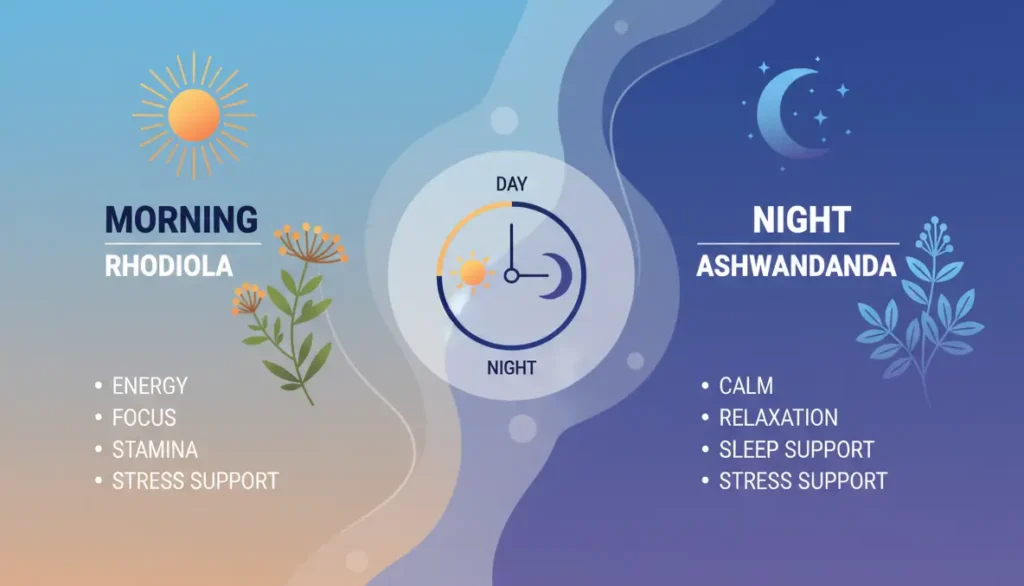
Not all adaptogens work the same way. Here’s how rhodiola compares:
| Adaptogen | Best Timing | Primary Effect | Energy Level | Sleep Impact |
|---|---|---|---|---|
| Rhodiola | Morning | Energizing, anti-fatigue | ⚡⚡⚡ High | Disrupts if taken late |
| Ashwagandha | Evening | Calming, stress-relief | 😴 Sedating | Promotes sleep |
| Cordyceps | Morning/Pre-workout | Energy, stamina | ⚡⚡ Medium-High | Can disrupt sleep |
| Reishi | Evening | Relaxing, immune support | 😴 Calming | Sleep-promoting |
| Holy Basil | Anytime | Balanced stress relief | ⚖️ Neutral | Minimal impact |
| Lion’s Mane | Morning | Cognitive enhancement | ⚡ Mild stimulation | Minimal impact |
| Maca | Morning | Hormone balance, energy | ⚡⚡ Moderate | Possible disruption |
The Pattern:
🌅 Morning Adaptogens (stimulating):
- Rhodiola rosea
- Cordyceps mushroom
- Asian ginseng
- Eleuthero (Siberian ginseng)
🌙 Evening Adaptogens (calming):
- Ashwagandha
- Reishi mushroom
- Schisandra (can go either way)
⚖️ Flexible Timing (balanced):
- Holy basil (tulsi)
- Shatavari
- Astragalus
The Perfect Daily Adaptogen Stack:
Morning (energy & focus):
- Rhodiola 400mg
- Cordyceps 500mg
- Lion’s Mane 1000mg (optional)
Evening (relaxation & recovery):
- Ashwagandha 600mg
- Reishi 1000mg
- Magnesium 400mg
This gives you the best of both worlds: daytime energy without anxiety, nighttime relaxation without grogginess.
Want a detailed breakdown? Check out our Rhodiola vs Ashwagandha comparison to see which fits your needs better.
How Long Does It Take to Feel Rhodiola?
Understanding rhodiola’s timeline helps you optimize timing and set realistic expectations.
Acute Effects (Same Day)
Energy boost: 30-60 minutes
- First thing you’ll notice
- Feels like mental and physical fog lifting
- Not jittery like caffeine
- More of a “clear-headed alertness”
Mental clarity: 1-2 hours
- Improved focus and concentration
- Easier to stay on task
- Reduced mental fatigue
Peak effects: 2-3 hours after taking
- Maximum energy and focus
- Best time for challenging tasks
- Optimal workout performance
Duration: 4-6 hours
- Gradual tapering of effects
- No crash like caffeine
- By evening, back to baseline (which is what you want)
Long-Term Benefits (Weeks)
The acute energy boost is nice, but rhodiola’s real magic happens over time as it builds adaptogenic resilience.
Stress resilience: 1-2 weeks
- Stressful situations feel less overwhelming
- Better emotional regulation
- Quicker recovery from stress
Mood improvements: 2-4 weeks
- More stable, positive mood
- Less anxiety
- Better stress-induced depression symptoms
Physical endurance: 2-3 weeks
- Noticeable improvement in exercise capacity
- Less fatigue during and after workouts
- Better overall stamina
Cognitive enhancement: 3-4 weeks
- Sustained improvements in memory
- Better mental processing speed
- Enhanced learning ability
Reddit long-term user experience: “First day I took rhodiola, I felt more energetic. Cool. But after three weeks of consistent use, I realized stress just wasn’t hitting me as hard. Things that would normally overwhelm me—work deadlines, family drama—I was handling calmly. That’s when I knew it was really working.”
Implication for timing: You’ll feel immediate energy effects within an hour, so morning dosing ensures those effects align with your active hours. But stick with it for at least 3-4 weeks to experience the full adaptogenic benefits.
Special Timing Considerations
Not everyone fits the standard “take it in the morning” box. Here are some special scenarios.
If You’re Taking Multiple Supplements
Stacking supplements requires strategic timing to avoid interactions and maximize benefits.
Smart Morning Stack:
- Upon waking: Rhodiola (empty stomach)
- 30 minutes later: Breakfast + Lion’s Mane, B-vitamins, Vitamin D
- With breakfast: Fish oil, multivitamin
- Optional: Coffee or green tea
What NOT to mix:
- Rhodiola + high-dose caffeine (start with half your usual coffee)
- Stimulating adaptogens together initially (can be too much)
- Rhodiola + energy drinks (unnecessary and potentially overwhelming)
Evening Stack (separate from rhodiola):
- With dinner: Ashwagandha, magnesium
- Before bed: Reishi, L-theanine
- Never with dinner: Rhodiola (too late!)
Rule of thumb: Don’t mix stimulating and sedating adaptogens at the same time. It’s counterproductive—like putting your foot on the gas and brake simultaneously.
If You’re Sensitive to Stimulants
Some people are extra sensitive to anything that increases energy or alertness. If that’s you:
Start very low:
- Begin with 100-200mg (half the standard dose)
- Take only in the morning (never afternoon)
- Don’t combine with coffee for the first week
- Assess your tolerance over 3-5 days before increasing
Signs you’re taking too much:
- Jitteriness or restlessness
- Increased anxiety (paradoxical reaction)
- Racing heart or palpitations
- Insomnia even from morning dose
- Feeling “wired but tired”
Solutions:
- Cut dose in half
- Take every other day instead of daily
- Switch to a gentler adaptogen (holy basil, ashwagandha)
- Avoid combining with caffeine
Reddit sensitive user: “I’m super sensitive to stimulants. Can’t even do coffee. But 200mg of rhodiola in the morning works great for me—gives me energy without anxiety. More than that and I get too wired.”
If You Have Bipolar Disorder
This deserves its own section because it’s important.
Important warning: Some anecdotal reports (including case studies in medical literature) suggest rhodiola might trigger manic or hypomanic episodes in people with bipolar disorder.
Why this might happen: Rhodiola increases dopamine and norepinephrine—the same neurotransmitters that can be elevated during manic phases.
Recommendations:
- Do NOT start rhodiola without consulting your psychiatrist
- If your doctor approves, start with a very low dose (100mg)
- Take only in the morning under medical supervision
- Monitor mood carefully using a mood tracking app
- Stop immediately if you notice mood destabilization
- Consider safer alternatives (ashwagandha may be better)
This is not just caution—it’s based on real reports. Better safe than hypomanic.
Dosage & Timing Guidelines by Goal
Let’s get prescriptive based on what you’re trying to achieve.
For Energy & Chronic Fatigue
Your Goal: Sustainable daily energy without crashes
Protocol:
- Dose: 400-600mg daily
- Timing: First thing in morning (6-8 AM)
- Form: Standardized extract (3% rosavins, 1% salidrosides)
- Duration: Daily for 8-12 weeks, then 2-week break
- Pair with: B-vitamins, CoQ10, adequate protein
Expect:
- Immediate energy within 30-60 min
- Long-term stamina improvement by week 2-3
- Better morning alertness
- No afternoon crash
Who this works for:
- People with chronic fatigue
- Those recovering from burnout
- Anyone tired of relying on coffee
For Athletic Performance & Endurance
Your Goal: Better workouts, improved endurance
Protocol:
- Dose: 400-600mg
- Timing: 60-90 minutes before training
- Form: Standardized extract
- Duration: On training days (no need on rest days, though some use daily)
- Pair with: BCAAs, creatine, beta-alanine
Expect:
- Enhanced endurance (studies show 3-24% improvement)
- Reduced perceived exertion (exercise feels easier)
- Better oxygen utilization
- Faster recovery between sets
- Mental focus during training
Studies back this up: Multiple clinical trials show rhodiola improves time to exhaustion, VO2 max, and overall exercise capacity.
Who this works for:
- Endurance athletes (runners, cyclists)
- Weightlifters and CrossFitters
- Anyone looking to level up their training
For Stress Management & Burnout Recovery
Your Goal: Build resilience, manage stress better
Protocol:
- Dose: 300-400mg daily
- Timing: Morning with breakfast
- Form: Standardized extract
- Duration: Minimum 4-6 weeks (adaptogenic effects take time)
- Pair with: Ashwagandha (evening), meditation, adequate sleep
Expect:
- Gradual improvement in stress response
- Better emotional regulation by week 2
- Less reactive to stressors by week 3-4
- Improved sense of well-being
- Better stress-related sleep quality
Who this works for:
- High-stress professionals
- People recovering from burnout
- Those with chronic stress but not clinical anxiety disorder
For Cognitive Function & Focus
Your Goal: Better mental clarity, focus, memory
Protocol:
- Dose: 300-500mg daily
- Timing: Morning, or 30-60 min before focused work
- Form: Standardized extract
- Duration: Consistent daily use (at least 3-4 weeks for cognitive benefits)
- Pair with: Lion’s Mane, Bacopa, coffee (moderate amounts)
Expect:
- Improved focus within an hour
- Better mental stamina throughout the day
- Enhanced memory consolidation over weeks
- Reduced brain fog
- Better performance under mental stress (exams, presentations)
Studies: Research shows rhodiola improves cognitive function, particularly under stressful conditions and during mental fatigue.
Who this works for:
- Students and academics
- Knowledge workers
- Anyone needing sustained mental focus
Common Timing Mistakes (And How to Fix Them)
Learn from others’ errors so you don’t have to make them yourself.
❌ Mistake #1: Taking It at Night
The problem: “I took rhodiola at 8 PM. Bad idea. Couldn’t sleep until after midnight. My brain wouldn’t shut off.”
Why this happens: Rhodiola stimulates alertness neurotransmitters at exactly the wrong time.
The fix: Take it in the morning only. No exceptions unless you’re a night shift worker starting your shift.
Prevention: Set a phone reminder for your morning dose so you don’t forget and take it later.
❌ Mistake #2: Inconsistent Timing
The problem: “I take rhodiola whenever I remember—sometimes morning, sometimes lunch, sometimes I forget for days. Not sure if it’s working.”
Why this matters: Adaptogens work best with consistent use. Sporadic dosing doesn’t allow the long-term adaptogenic benefits to build.
The fix:
- Choose one consistent time (morning is best)
- Use a pill organizer
- Set a daily phone alarm
- Pair it with an existing habit (making coffee, brushing teeth)
Why consistency matters: Your body adapts to the routine, and cumulative effects build over time.
❌ Mistake #3: Taking Too Late in the Day
The problem: “I take rhodiola at 2 PM with lunch. I sleep okay, but my sleep tracker shows less deep sleep.”
Why this happens: Even if you don’t feel wired, rhodiola taken in the afternoon can subtly affect sleep quality.
The fix: Move your dose to morning. If you need an afternoon energy boost, try a much smaller dose (100-200mg) before 1 PM only.
The 8-hour rule: Don’t take rhodiola within 8 hours of your planned bedtime.
❌ Mistake #4: Expecting Instant Miracles
The problem: “Took rhodiola for three days. Don’t feel any different. This stuff doesn’t work.”
Why this happens: While energy effects are immediate, the deeper adaptogenic benefits (stress resilience, mood improvement) take weeks.
The fix:
- Commit to at least 2-3 weeks before judging effectiveness
- Track your energy, mood, and stress levels daily
- Look for subtle improvements, not dramatic overnight changes
- Remember: adaptogens adapt—they fine-tune, not bulldoze
Realistic timeline:
- Day 1-3: Mild energy boost
- Week 1-2: More noticeable energy and focus
- Week 3-4: Real stress resilience kicks in
- Week 6-8: Full adaptogenic benefits
❌ Mistake #5: Not Adjusting for Individual Response
The problem: “Everyone online says 600mg is the sweet spot. I take 600mg and feel anxious and jittery.”
Why this happens: Generic advice doesn’t account for individual body weight, metabolism, sensitivity, and genetics.
The fix:
- Start low (200-300mg) regardless of what “everyone does”
- Increase gradually over 1-2 weeks
- Find YOUR optimal dose (might be 300mg, might be 800mg)
- Adjust based on how you actually feel, not what internet strangers recommend
Reddit wisdom: “What works for someone else might not work for you. Titrate your dose and listen to your body.”
Optimizing Rhodiola: Pro Tips From Long-Term Users
💡 Pro Tip #1: Cycle It to Prevent Tolerance
The strategy:
- Take rhodiola daily for 8-12 weeks
- Take a 2-4 week break
- Resume if needed
Why cycling works:
- Prevents receptor downregulation
- Maintains effectiveness over time
- Gives your body a reset
- You might realize you don’t even need it anymore (your resilience improved!)
Reddit long-term user: “I cycle all my adaptogens. Eight weeks on, two weeks off. Keeps them working effectively. When I skip the breaks, I notice diminishing returns.”
💡 Pro Tip #2: Pair With Coffee (But Carefully)
Many people report excellent synergy between rhodiola and coffee.
The combo:
- Rhodiola: 300-400mg
- Coffee: 50-100mg caffeine (half your usual amount)
- Timing: Both in the morning
Why it works:
- Different mechanisms (rhodiola = adaptogens, coffee = adenosine blocker)
- Rhodiola reduces coffee’s jittery side effects
- Coffee enhances rhodiola’s alertness
- Longer-lasting energy than coffee alone
Start conservatively: If you normally drink 2 cups of coffee, start with 1 cup when adding rhodiola. See how you feel. Some people can keep their normal coffee intake; others need to reduce it.
Warning signs it’s too much:
- Anxiety or jitteriness
- Racing heart
- Can’t sit still
- Insomnia even from morning dose
💡 Pro Tip #3: Stay Hydrated
Rhodiola, especially when used for exercise, increases your body’s demand for water.
Hydration protocol:
- Drink 16 oz water when you take rhodiola
- Add 8-16 oz more than usual throughout the day
- Even more if exercising
Why: Dehydration can mimic or worsen rhodiola side effects (headache, irritability).
💡 Pro Tip #4: Track Your Response
Don’t rely on memory. Track objectively.
What to track (daily for first month):
- Time you took rhodiola
- Dose
- Energy level (1-10 scale)
- Focus/productivity (1-10)
- Mood (1-10)
- Sleep quality that night (1-10)
- Any side effects
Why this matters: You’ll spot patterns (optimal dose, best timing, what works, what doesn’t) that you’d otherwise miss.
Tools:
- Simple notebook
- Phone notes app
- Habit tracking apps (Habitica, Streaks)
💡 Pro Tip #5: Quality Matters More Than You Think
Not all rhodiola supplements are created equal. Quality varies wildly.
Look for:
- Standardized extract: 3% rosavins and 1% salidrosides (these are the active compounds)
- Third-party tested: USP, NSF, ConsumerLab, or Informed-Sport certification
- Reputable brands: Now Foods, Gaia Herbs, Thorne,
What to avoid:
- Unknown Amazon brands with fake reviews
- Products without standardization info
- Proprietary blends (you don’t know how much you’re getting)
- Suspiciously cheap options
Want specific recommendations? Check out our detailed review of the Best Rhodiola Supplements 2025 where we test and compare top brands.
Frequently Asked Questions
Can I take rhodiola every day?
Yes, rhodiola is safe for daily use, but cycling is recommended. Take it consistently for 8-12 weeks, then take a 2-4 week break. This prevents tolerance buildup and maintains effectiveness. Many long-term users follow this pattern successfully.
Will rhodiola keep me awake at night if I take it in the morning?
No. When taken in the morning, rhodiola’s effects typically last 4-6 hours. By evening, it’s worn off, and most people sleep normally. In fact, many users report better sleep quality because they’re less stressed during the day. The issue only arises if you take it too late (after 2-3 PM).
Can I take rhodiola with coffee?
Yes, and many people love this combination. Start with half your usual coffee amount when first adding rhodiola to assess tolerance. The two work synergistically—rhodiola can actually reduce coffee’s jittery side effects while coffee enhances rhodiola’s alertness. Just don’t overdo it.
What if I forget to take rhodiola in the morning?
If you remember before 2 PM, take it then. After 2 PM, skip that day’s dose and resume your morning routine tomorrow. Don’t take it late in the day to “catch up”—that’s a recipe for sleep problems. Missing one day won’t set you back.
How long before I feel rhodiola working?
You’ll feel energy effects within 30-60 minutes of taking it. However, the deeper adaptogenic benefits—improved stress resilience, better mood, enhanced endurance—develop over 2-4 weeks of consistent use. Give it at least 3 weeks before deciding if it’s working for you.
Can I take rhodiola before bed if I work night shifts?
Yes, but time it correctly. Take rhodiola at the start of your “day” even if that’s 6 PM. The key is to avoid taking it within 6-8 hours of when you plan to sleep. So if you sleep from 8 AM to 4 PM, taking rhodiola at 6 PM (start of your waking period) is fine.
Is rhodiola better than ashwagandha?
They serve different purposes. Rhodiola is energizing and best for physical energy, mental alertness, and acute stress performance. Ashwagandha is calming and best for chronic stress, anxiety, and sleep. Many people take both: rhodiola in the morning, ashwagandha at night. Read our full Rhodiola vs Ashwagandha comparison for details.
Final Thoughts: Getting Your Rhodiola Timing Right
Let’s bring this all together with the key takeaways.
The bottom line:
- Rhodiola is a morning supplement—take it in the morning (6-8 AM) for best results
- It’s stimulating, not sedating, so night-time dosing will likely disrupt sleep
- Empty stomach absorption is best, but with food works fine if needed
- Effects are fast (30-60 min) but full benefits take weeks
- Consistency matters more than perfect optimization
Your action plan:
Week 1: Start with 300mg in the morning on empty stomach Week 2: If no issues, increase to 400-600mg Week 3-8: Stay consistent, track your response Week 9: Take a break if you’ve been using for 8-12 weeks
Listen to your body: Your body will tell you if you’ve got the timing right.
- Morning energy without crashes? ✅ Nailed it.
- Restless nights? ⏰ Too late in the day.
- No noticeable effects? 📊 Try adjusting dose or timing.
Final wisdom from Reddit: “Rhodiola changed my life, but only after I figured out the timing. Took it at night initially—disaster. Moved it to 6 AM with my coffee—perfect. Same supplement, completely different results. Timing matters.”
Ready to Try Rhodiola?
Helpful Resources:
- Best Rhodiola Supplements 2025 – Our top tested picks
- Rhodiola vs Ashwagandha – Which adaptogen is right for you?
- Complete Guide to Adaptogens – Master class on all adaptogens
- Rhodiola Dosage Guide – Detailed dosing strategies
Have questions or your own rhodiola timing experiences? Drop a comment below. And if this guide helped you, share it with someone who’s struggling with rhodiola timing.
Stay energized (at the right times),
The HerbzWay Team
References: Clinical studies on rhodiola timing and effectiveness, r/Nootropics community discussions, Journal of Sports Medicine research on rhodiola and performance
Note: This article is regularly updated with the latest research and user experiences. Last updated: December 2025

